

Getting Found in AI Search: The New Local Frontier
The Search Landscape Is Changing — Are You Ready?
If you're running a service business, the goal used to be simple: rank #1 on Google. Show up at the top of the search results, and the phone rings. Build a few reviews, keep your website updated, and you're competitive.
But something fundamental has shifted. Homeowners and local clients aren't just "Googling" anymore. They're turning to AI-powered platforms — ChatGPT, Gemini, and Perplexity — for recommendations. They're asking:
- "Who is the most reliable HVAC company in Houston?"
- "Find me a top-rated painter near me with great reviews."
- "What's the best emergency plumber in Dallas that's available on weekends?"
These aren't traditional keyword searches — they're conversations with AI, and AI is answering them with curated recommendations. The question is: will your business be one of those recommendations?
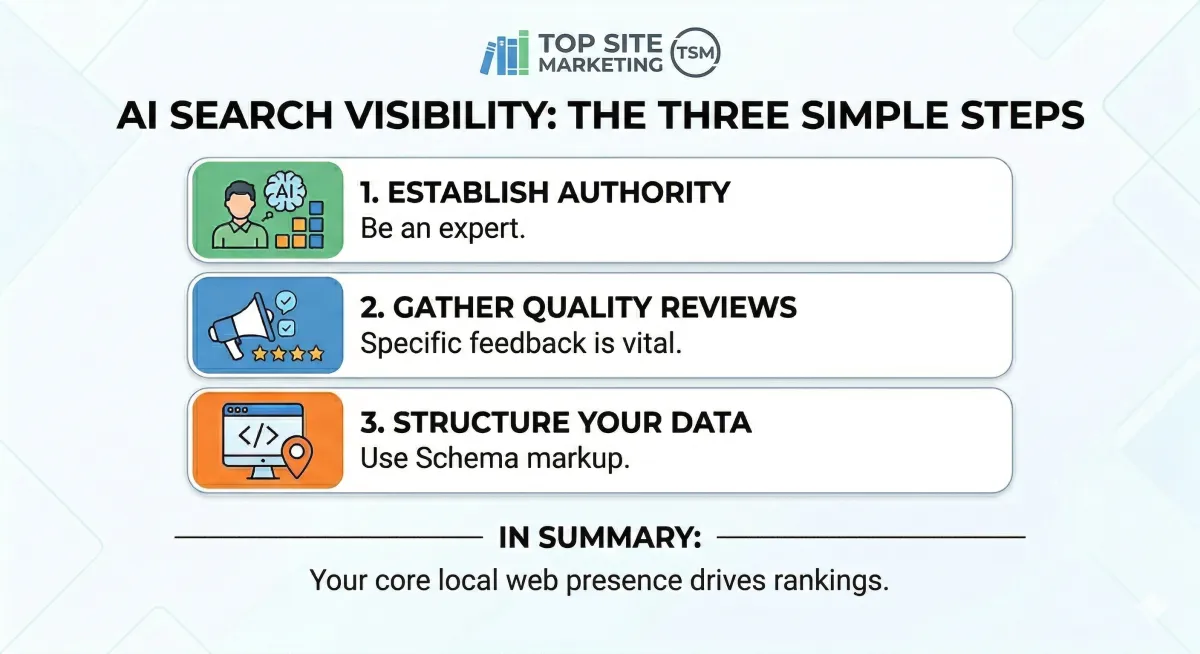
At Top Site Marketing, we specialize in positioning local service businesses to win in this new AI-driven landscape. Here are the four most important strategies you need to implement right now.
1. Build “Topical Authority” on Your Website
One of the biggest misconceptions local business owners have is that a simple website is enough. A home page, a services page, and a contact form. Done.
In the world of AI search, that's no longer sufficient. AI models don't just look at keywords — they look at knowledge. When an AI system evaluates whether to recommend your business, it's assessing whether your digital presence demonstrates genuine expertise in your field.
If your website only has a “Home” and “Contact” page, AI won't see you as an expert. It's that simple.
The Fix: Create Deep Content Silos
Content silos are clusters of related content that establish you as an authority on a specific topic. Instead of a single “Plumbing Services” page, think about building out content like:
- “How to prevent pipe bursts in Texas winters”
- “The pros and cons of tankless water heaters for Houston homeowners”
- “Signs your water heater needs to be replaced”
- “Emergency plumbing: what to do before the plumber arrives”
AI systems crawl all of this content and use it to determine whether you actually know your craft. The more depth and specificity you demonstrate, the more likely AI is to trust — and recommend — your business.
2. Dominate the “Citation” Ecosystem
AI models are built to be accurate. When they make a recommendation, they're not just pulling from one source — they're cross-referencing multiple data points to verify that a business is legitimate and trustworthy.
Those data points are your citations: your business listings across platforms like Google Business Profile, Yelp, Angi, HomeAdvisor, the Better Business Bureau, and dozens of industry-specific directories.
The Fix: Achieve Perfect NAP Consistency
NAP stands for Name, Address, and Phone number. Every single directory where your business appears needs to show identical NAP data. Not similar — identical.
If your Google Business Profile shows “123 Main Street” but Yelp shows “123 Main St.”, that inconsistency creates what AI algorithms interpret as distrust signals. It raises questions: Is this the same business? Is this information current?
Audit every directory where you're listed and ensure every character matches. This is foundational work, but it has an outsized impact on how AI evaluates and recommends your business.
3. Focus on “Sentiment” and Review Specificity
Most business owners understand that reviews matter. More reviews, higher star ratings, better ranking. But in the AI era, the content of your reviews matters just as much as the quantity.
AI is incredibly good at reading tone and extracting meaning. It doesn't just count your five-star reviews — it reads them. It analyzes the language, identifies the services mentioned, and builds a picture of what your business actually does and how well it does it.
The Fix: Implement an Automated Review System
Rather than hoping customers leave detailed reviews on their own, implement a system that guides them to leave the right kind of review. When a customer has a great experience, your follow-up process should encourage them to mention:
- The specific service they received (“emergency AC repair,” “tankless water heater installation”)
- The location or neighborhood (“in Katy,” “near Sugar Land,” “in The Woodlands”)
- Specific outcomes (“fixed my compressor the same day,” “saved us thousands with a quick diagnosis”)
When reviews say things like “best emergency AC repair in Katy — they fixed my compressor in under two hours,” AI directly associates your brand with those high-intent, location-specific searches. That's incredibly powerful for your local visibility.
4. Implement Structured Schema Markup
Schema markup is the technical foundation that ties everything together. It's the “behind-the-scenes” code embedded in your website that tells search engines and AI systems exactly what your business is, what it does, and who it serves.
Without schema, AI has to “guess” at your business information by reading your web content. With schema, you're feeding AI engines structured, precise data in a language they can instantly parse and trust.
The Fix: Use Advanced Local Business Schema
At minimum, your website should include Local Business Schema that specifies:
- Your business name, address, phone number, and hours
- Your specific service offerings
- Your service area (cities, zip codes, or radius)
- Your price range
- Your aggregate review rating
Advanced implementations also include Service Schema for individual services, FAQ Schema for common customer questions, and Review Schema that surfaces your star ratings directly in search results. Each layer of schema gives AI one more data point to confidently include your business in its recommendations.
The Bottom Line: Double Duty SEO
The “search” engine is becoming an “answer” engine. The way local customers find service businesses is fundamentally changing, and the businesses that adapt now will have a significant head start on those who wait.
Here's the good news: best-practice Local SEO does double duty. Every strategy outlined above — building topical authority, maintaining NAP consistency, gathering high-quality reviews, and implementing schema markup — helps you rank in the traditional Google Map Pack and positions your business to be the primary recommendation in AI search results.
You're not choosing between traditional SEO and AI optimization. Done right, they're the same thing.
At Top Site Marketing, we specialize in implementing these strategies for local service businesses in Houston and across Texas. If you want to ensure your business is visible in both traditional and AI-powered search results, reach out today at (832) 209-7544 for a free Local SEO consultation.


